Why Sri Lankan Businesses Are Choosing Local Tech Partners Over Global SaaS in 2026
Every global SaaS company serves Sri Lanka as an afterthought. The payment method is not designed for Sri Lankan banks. The support team is in a timezone that is asleep during your working day. The pricing is in a currency that has cost local businesses thousands of extra rupees every year without a single price increase from the provider. The shift to local-first is not nostalgia. It is economics.
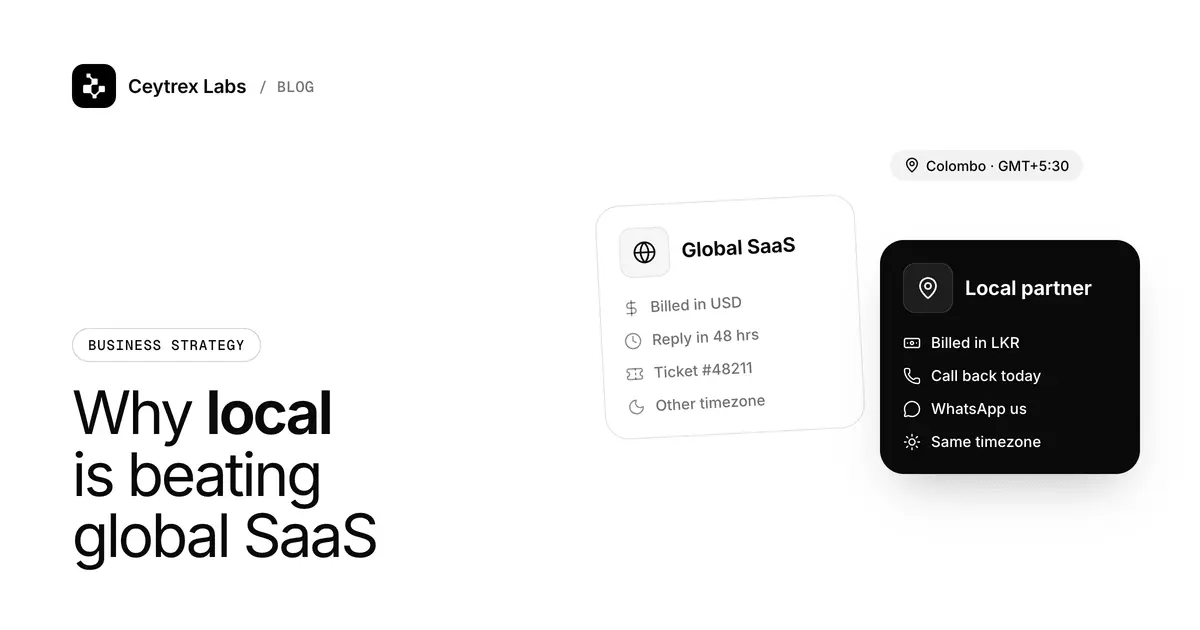
Global software is often excellent, and some of it is the right choice for a Sri Lankan business. But it is built for a buyer who pays in dollars with an international card, works in a US or European time zone and has no need for Sinhala or Tamil. This guide compares a local technology partner with global SaaS on the things that actually affect a Sri Lankan owner: currency, cards, support hours and fit, and it is honest about where the global tools still win.
Quick answer: A local partner usually wins on LKR pricing (no exchange-rate surprises), payment with a local card, support during Sri Lankan working hours, and help that fits how you actually sell, such as WhatsApp, Sinhala and Tamil, and local payment gateways. Global tools usually win on depth of features, integrations, global scale and self-service documentation. Many businesses end up with a mix: global tools for email, office and accounting, and a local partner for the website, hosting and customer messaging.
The comparison at a glance
| Factor | Typical global SaaS | Typical local partner |
|---|---|---|
| Billing currency | USD (sometimes EUR); the rupee cost moves with the exchange rate | LKR; the price you see is the price you pay |
| Payment method | International card, often charged automatically on renewal | Local cards through a Sri Lankan gateway; bank transfer is often possible |
| Renewal price | Introductory discounts often end on renewal | Varies by provider; ask for the renewal price in writing |
| Support hours | Set by the vendor, often a global queue with a time difference | Sri Lankan business hours |
| Support style | Self-service docs, tickets, chat | Phone, WhatsApp and email with people who know your setup |
| Features and integrations | Usually deeper, with large app ecosystems | Narrower, but can be built or adapted for you |
| Local fit | Rarely aware of local gateways, NIC formats or Poya-day schedules | Built around local payment, language and business habits |
| Scale and redundancy | Usually very large infrastructure | Smaller teams; ask what happens if a key person is away |
Currency: the cost you do not see on the price list
A USD price that never changes can still cost more rupees every year. In 2022 the rupee depreciated by 44.8 per cent against the US dollar, according to the Central Bank of Sri Lanka Annual Report 2022, after the Central Bank allowed greater flexibility in the exchange rate in March 2022 (CBSL policy package). Any business paying for dollar-priced software that year saw its rupee cost rise sharply with no change in the vendor's price.
The rate has been far calmer since, and it can move in your favour as well. The point is not that the rupee will fall again; it is that a dollar subscription carries a risk your LKR revenue does not cover. You can check the current and historical rate on the CBSL exchange rates page. Your bank also adds its own rate and any fees for foreign-currency card transactions, so the amount on your statement can differ from the vendor's price.
Example: a tool priced at USD 30 a month costs whatever 30 dollars costs on your bank's card rate that day, every month. An LKR price stays the same in rupees until the provider changes it, which makes a yearly budget simpler.
Cards and renewals
Global SaaS usually expects an international card on file and charges it automatically. Some Sri Lankan cards are not enabled for foreign-currency online payments or have limits on them, so check with your bank. When a renewal charge fails, some services suspend the account after a short grace period, and the warning email can easily be missed.
With a local provider you normally pay in LKR with a local card. At Ceytrex Labs, payments go through Ceytrex Pay, with cards processed by PayHere; amounts over LKR 50,000 are split into parts on the same checkout. Our hosting does not charge your card automatically: you get a reminder before renewal and renew from your dashboard, and renewals are charged at the price you first paid. See hosting for plan details.
Support hours and who answers
Sri Lanka is UTC+5:30. A support team in the US is usually off shift during most of the Colombo working day, and even a 24/7 global team may route you to someone who has never heard of your payment gateway. That is not a criticism of their skill; it is a mismatch of context.
Ceytrex Labs support runs Monday to Friday, 9 AM to 6 PM Sri Lanka time, by phone and WhatsApp on +94 770 363 796 and by email at hello@ceytrexlabs.com, with general replies within 24 hours. We will not pretend to be a 24/7 operation. If you need round-the-clock cover, ask any provider, local or global, exactly what is covered out of hours.
Fit: building for how Sri Lankan businesses sell
Local fit shows up in small but daily details: customers who message on WhatsApp instead of filling in forms, parents and older customers who prefer SMS, Sinhala and Tamil alongside English, card checkout through a Sri Lankan gateway, and schedules that respect public holidays and Poya days. A few examples from our own products:
- Ceytrex Agent answers customer questions on WhatsApp and your website in English, Sinhala and Tamil, and hands the chat to your staff when a person is needed.
- Ceytrex eSMS sends SMS from your own sender ID, priced per SMS in rupees; our eSMS guide explains the costs.
- Ceytrex Tickets sells event tickets with LKR card checkout and QR entry for schools, clubs and associations.
- Ceytrex Toolkit includes free Sri Lanka tools such as an NIC decoder, EPF/ETF and APIT calculators and a Sinhala Unicode to FM/DL font converter.
Where global tools still win
A fair comparison has to say this clearly. Choose global tools when:
- You need depth and an ecosystem. Office suites, accounting platforms, design tools and large CRMs have years of features and hundreds of integrations that no small local provider can match.
- You sell internationally. Multi-currency checkout, global tax handling and infrastructure in several regions are what global platforms are built for.
- You want self-service. Global tools usually have thorough documentation, video tutorials and community forums, which suits teams that prefer to solve problems themselves.
- You need scale and certifications. Large enterprises with formal security or compliance requirements may need vendors with specific certifications and very large infrastructure.
- The product is a commodity. For email, video calls or file storage, the global leaders are reliable and the local alternative adds little.
In practice, many Sri Lankan businesses use a global office suite and accounting tool, and a local partner for the parts that touch local customers: the website, hosting, domain, WhatsApp and SMS, and payments in LKR.
How to choose: questions to ask any provider
- What is the renewal price, not just the first-year price, and in which currency?
- How do I pay, and what happens if a payment fails?
- What are your support hours in Sri Lanka time, and how do I reach a person?
- Who owns my domain, data and accounts, and can I take them elsewhere?
- What backups do you keep, and how do I restore one?
- If you are a small team, who covers when the person I deal with is away?
Keep your own assets portable whoever you choose: register your domain in the business's name, keep the logins, and make sure your website can be moved to another cPanel host. Our cPanel hosting explainer and Ceytrex vs GoDaddy comparison cover what to check.
Frequently Asked Questions
Is local always cheaper than global?
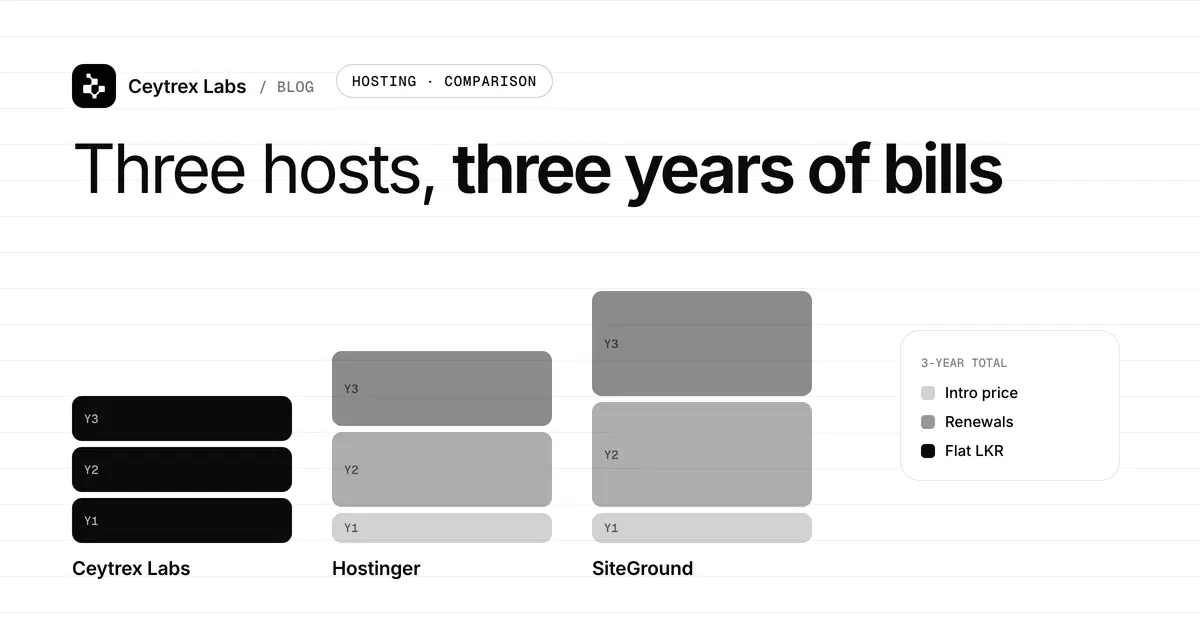
No. Some global tools have generous free tiers, and local budget hosts advertise lower prices than ours. Compare the total cost over two or three years, including renewals, payment fees and the time you spend getting help.
Am I locked in if I use a local provider?
You should not be. Ask for your domain to be registered in your name and for standard tools such as cPanel, so files, databases and email can move to another host. Your WhatsApp number and WhatsApp Business account should stay in your name too.
Which exchange rate should I use to compare a USD price?
For a rough comparison, use the CBSL indicative rate. For the real cost, use your bank's card rate plus any foreign transaction fee, which is what appears on your statement.
Can a local partner work alongside our global tools?
Yes. Most of what we build connects to other systems through APIs; for example, your website or billing system can send SMS through the Ceytrex eSMS API. Ask any provider how their product connects to the tools you already use.
Talk to a team in your time zone
Tell us what you use today and what is not working. We will tell you honestly which parts we can help with and which tools you should keep.
Sources
- Central Bank of Sri Lanka Annual Report 2022, Chapter 5 - rupee depreciation of 44.8 per cent against the US dollar in 2022
- CBSL policy package, March 2022 - greater exchange rate flexibility
- CBSL exchange rates - current and historical indicative rates
- PayHere - the card processor behind Ceytrex Pay