How Much Should You Spend on Facebook Ads in Sri Lanka? A Budget Guide That's Actually Useful
"Boost this post for LKR 500" is not a marketing strategy. Neither is "I'll spend LKR 100,000 per month and see what happens." Here is how to set a Facebook ads budget based on your actual business goal - with LKR figures that reflect Sri Lanka's market.
Most owners pick an ad budget by feel - whatever is left at the end of the month. A better way is to work backwards from what a customer is worth to you, how many inquiries it takes to win one, and how much Meta needs to spend before its numbers mean anything. This guide walks through that maths in rupees, then covers test budgets, scaling, and the practical side of paying Meta from Sri Lanka.
Quick answer: Your maximum cost per lead is the gross profit on a typical sale multiplied by your close rate. Aim to pay well under that, then multiply your target cost per lead by the number of leads you need to hit your sales goal - that is your monthly budget. Test with one campaign for one to two weeks before scaling, raise budgets gradually, and pay with a card that is enabled for international online payments, with a backup method on the account.
Step 1 - Work Out the Cost Per Lead You Can Afford
There is no "normal" cost per lead for Sri Lanka. It changes with your industry, location, offer, creative and season. What you can calculate exactly is what a lead is worth to your business, and that gives you a ceiling.
- Gross profit per sale: the average first order or project value minus what it costs you to deliver it. Use profit, not revenue - a LKR 100,000 sale with a 20% margin is worth LKR 20,000 to your ad budget.
- Close rate: out of every 10 genuine inquiries, how many buy? Count from your WhatsApp chats, call log or CRM for the last two or three months. If you have never tracked it, start now and use a cautious guess until you have real numbers.
- Break-even cost per lead: gross profit per sale multiplied by close rate. Above this number, every lead loses money (before repeat purchases).
- Target cost per lead: pick a number comfortably below break-even - many businesses aim for half - so the campaign still earns money when results vary week to week.
- Monthly budget: customers you want from ads, divided by close rate, multiplied by target cost per lead.
| Illustration: custom furniture shop | Value | How it is worked out |
|---|---|---|
| Average order value | LKR 120,000 | Assumed for the example |
| Gross margin | 30% | Assumed for the example |
| Gross profit per order | LKR 36,000 | 120,000 × 30% |
| Close rate on WhatsApp inquiries | 1 in 10 (10%) | Assumed for the example |
| Break-even cost per lead | LKR 3,600 | 36,000 × 10% |
| Target cost per lead | LKR 1,800 | Half of break-even |
| Goal | 6 orders a month | Needs 60 leads (6 ÷ 10%) |
| Monthly budget at target | LKR 108,000 | 60 × 1,800 |
If LKR 108,000 is more than the shop can spend, the maths tells it what a smaller budget can realistically buy. At LKR 50,000 and the same target cost per lead, that is roughly 27 leads and two or three orders a month - still profitable, as long as the cost per lead stays near target. These figures are an illustration; plug in your own.
The two levers that change this maths the most are outside Ads Manager. Raising your close rate (faster replies, better follow-up, clearer pricing) lifts the cost per lead you can afford. Our guide on WhatsApp response time and sales covers the follow-up side. For leads who are not ready yet, email and SMS campaigns through Ceytrex Marketing costs far less than paying Meta to reach them again.
Step 2 - Set a Test Budget
Before committing a monthly budget, run a test that answers one question: can this offer and creative produce leads near your target cost? Meta says an ad set usually exits the learning phase after about 50 results in the week after its last significant edit (Meta: About the learning phase). At a target cost per lead of LKR 1,800, that would mean LKR 90,000 a week - more than most small businesses spend in a month.
That is fine. Many SME ad sets stay "Learning limited" and still produce profitable leads. It just means you should judge on a longer window and on lead quality, not on two days of data. A practical test plan we use:
- One campaign, one ad set, two to four ads with genuinely different hooks or offers.
- Run for 10-14 days without changing the budget or audience.
- Budget enough for each ad to spend at least two or three times your target cost per lead. In the illustration, three ads × LKR 5,400 is about LKR 16,000 at minimum; LKR 25,000-35,000 over two weeks gives a clearer read.
- Pause an individual ad once it has spent about twice your target cost per lead with no leads at all. This is a working rule of thumb, not a Meta rule.
- At the end, compare cost per qualified lead from your own lead sheet, not just the cost per result Ads Manager shows.
How Meta Spends a Daily Budget
A daily budget is an average, not a hard daily cap. Meta has said it is increasing daily budget flexibility from 25% to 75% - it may spend more on days with better opportunities - but on a weekly basis it will not spend more than seven times your daily budget (Meta for Developers: Marketing API v24.0 announcement).
Illustration: a monthly budget of LKR 50,000 is about LKR 1,645 a day (50,000 ÷ 30.4). Some days may spend noticeably more than that, but a week will not exceed about LKR 11,500 (7 × 1,645). If your cash flow cannot absorb uneven days, set an account spending limit as well.
Step 3 - Scale Without Breaking What Works
Meta advises against frequent budget changes and says big or frequent edits can push an ad set back into the learning phase (Meta: About the learning phase). Meta does not publish an exact percentage. The rules below are how we and many practitioners handle it:
- Only scale what is proven. At least a week or two at or below target cost per qualified lead, with your team able to handle more inquiries.
- Raise gradually. Increase the budget by roughly 20% at a time and wait three or four days before the next increase, so you can see whether costs hold.
- Duplicate for big jumps. If you want to double spend, duplicate the winning ad set at the higher budget and leave the original running.
- Feed it new creative. Spending more in the same audience raises frequency. Add new ads as you scale rather than pushing one ad harder.
- Widen before you narrow. If costs rise, test a wider location (for example Western Province instead of Colombo district) before adding more detailed targeting.
- Watch lead quality. Costs per lead often rise as you scale. That is acceptable while you stay under break-even; it is not acceptable if the extra leads stop buying.
Paying Meta From Sri Lanka
Sri Lankan rupees are not on Meta's list of supported ad account currencies (Meta for Developers: Currency codes), so most Sri Lankan ad accounts are billed in US dollars. Meta accepts credit cards, co-branded debit cards and PayPal in supported currencies (Meta: Accepted payment methods). Choose the account currency carefully when you create the ad account, because changing it later means setting up a new ad account.
- Enable international online payments on the card before your first charge. Several Sri Lankan banks keep this off by default, and a declined charge pauses your ads.
- Know how you are charged. With automatic payments, Meta charges your card each time spend reaches your payment threshold, and again on your monthly bill date for anything left over (Meta: How Meta charges for ads).
- Match the threshold to your card limit. If your card limits the size of a single transaction, Meta suggests lowering your payment threshold to match (Meta: Preventing payment failures).
- Add a backup payment method so a declined card does not stop a campaign that is working.
- Budget for the exchange rate. Your bank converts each USD charge at its own rate and may add a foreign-currency fee. Check the rate on your statement against the Central Bank of Sri Lanka reference rate to see what you are really paying.
- Use a business card where possible, and keep Meta's receipts from Billing and payments in Ads Manager for your accounts.
| Illustration: LKR to USD | At an assumed LKR 300 per USD | Daily average |
|---|---|---|
| LKR 25,000 a month | about USD 83 | about USD 2.75 |
| LKR 50,000 a month | about USD 167 | about USD 5.50 |
| LKR 100,000 a month | about USD 333 | about USD 11 |
The rate above is only for illustration - use the current rate and your bank's charges for your own planning.
Tax note: Check with your accountant whether VAT applies to your Meta invoices, and whether your business needs to account for it, before you set your budget - the rules for digital services bought from overseas companies are worth confirming on the IRD website. Meta's billing pages also note that it adds location fees in some jurisdictions, so read the line items on your receipts.
Where the Budget Leaks After the Click
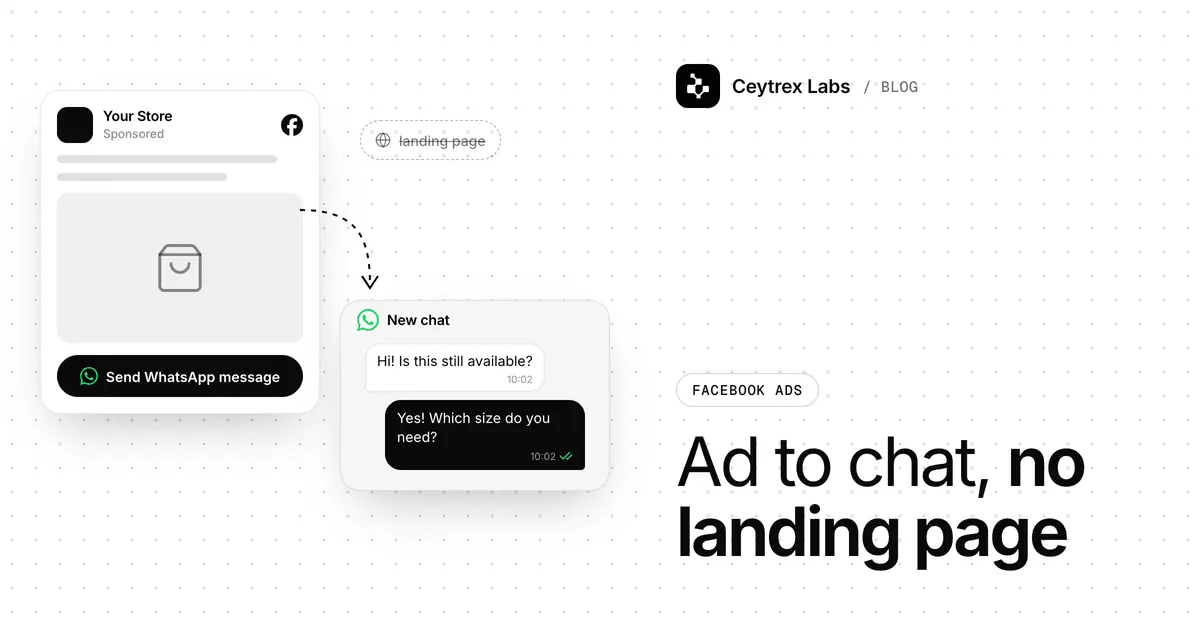
A good cost per lead is wasted if the next step fails. If ads send people to a website, a slow mobile page loses them before the form loads - see our website speed guide. If ads open WhatsApp, someone has to reply quickly; our guide to Facebook ad leads without a landing page covers that route. Choosing the right objective in the first place is covered in Meta ads for Sri Lankan businesses.
Frequently Asked Questions
Can I run Facebook ads with LKR 5,000 a month?
Yes, but treat it as a small experiment rather than a lead machine. At that level a single ad set gets very few results, so you will mostly learn whether an ad gets any response at all. It works better for keeping a local business visible, or for retargeting people who already visited your website, than for cold lead generation.
Daily budget or lifetime budget?
Daily budgets are easier to control and to scale step by step, so start there. Lifetime budgets suit campaigns with a fixed end date, such as an event or a two-week sale, because Meta can spread the spend across the dates and you can schedule ads to run only during certain hours.
Should I use campaign budget or ad set budgets?
With one ad set it makes no difference. With several ad sets, a campaign budget (Advantage+ campaign budget) lets Meta move money to whichever ad set is getting cheaper results. Use ad set budgets only when you need to guarantee spend on a particular audience, such as a retargeting ad set that would otherwise get almost nothing.
My card keeps getting declined. What can I check?
Confirm that international online transactions are enabled, that the card has enough limit for your payment threshold, and that the billing country matches. Then lower the payment threshold if your card has a per-transaction limit, and add a backup payment method. Most declines we see are bank-side settings, not Meta problems.
How much of the budget should go to retargeting?
Retargeting audiences in Sri Lanka are usually small unless your website or videos get steady traffic, so they cannot absorb much money. Start with a small fixed amount for website visitors and video viewers, and put the rest into prospecting. If retargeting frequency climbs high, it is getting too much.
Make every rupee of ad spend land on a page that converts
Ceytrex Labs builds fast landing pages and business websites with lead tracking and the Meta Pixel set up. Landing pages from LKR 45,000, fixed quote after a free consultation.
Sources
- Meta: About the learning phase - about 50 results a week to exit learning; avoid frequent budget changes
- Meta for Developers: Graph API and Marketing API v24.0 - daily budget flexibility of up to 75% and the weekly 7× cap
- Meta for Developers: Currency codes - currencies supported for ad accounts
- Meta: Accepted payment methods for Meta ads - cards, co-branded debit cards and PayPal
- Meta: How Meta charges for ads - budgets, payment thresholds, location fees
- Meta: Best practices for preventing payment failures - card limits, thresholds and backup methods
- Central Bank of Sri Lanka - official exchange rates
- Inland Revenue Department - VAT notices and guidance