Google SEO for Sri Lankan Businesses in 2026 - What Actually Works
A Meta ad campaign stops delivering leads the moment you stop spending. A page that ranks on Google can keep bringing visitors for years with no cost per click. SEO for Sri Lankan businesses is underused, misunderstood, and often handed to agencies who produce reports but no rankings. Here is the process that works in 2026.
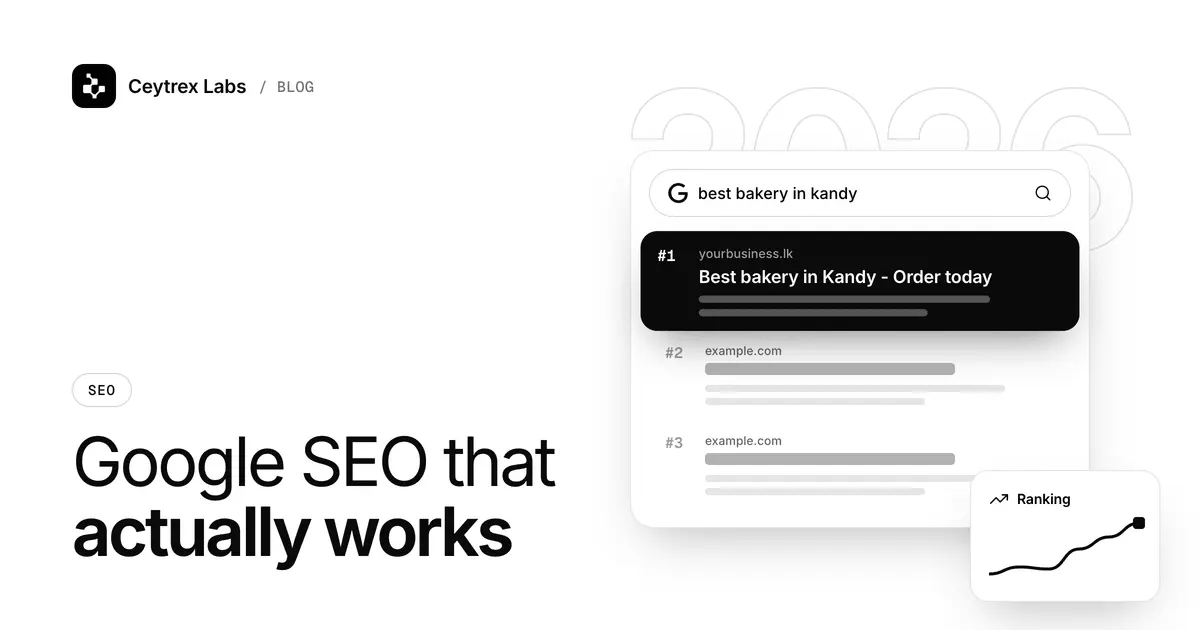
An ad campaign stops the day the budget runs out. A useful page that ranks on Google can keep bringing in customers for years without a cost per click. For most Sri Lankan SMEs, SEO is not a mystery - it is a process: make sure Google can find and read your site, learn the words customers actually search (in English, Sinhala, Tamil and Singlish), build pages that answer those searches better than anyone else, and keep at it. This guide sets out that process, based on Google's own documentation rather than ranking folklore.
Quick answer: Set up Google Search Console and fix anything stopping Google from indexing your pages. Find real customer searches from Search Console, Google autocomplete and your own WhatsApp inquiries. Give each important service its own clear, genuinely helpful page with a descriptive title, make the site fast on mobile, verify your Google Business Profile, and avoid shortcuts such as bought links or keyword stuffing, which break Google's spam policies.
SEO and Ads Do Different Jobs
| Meta or Google ads | Organic SEO | |
|---|---|---|
| Speed | Results within days | Google says some changes take hours, others several months |
| Cost | Pay for every click or result | Pay in time and content; no cost per click |
| When you stop | Traffic stops | Rankings can persist, though they fade without upkeep |
| Intent | Ads interrupt people scrolling (social) or appear for searches (Google Ads) | You appear when people are actively searching |
Most businesses benefit from both: ads for immediate demand, SEO for compounding traffic. If you also run Meta ads, our Meta ads guide covers that side.
What Google Actually Says Matters
Google publishes far more guidance than most owners realise. Three documents are worth reading in full:
- SEO Starter Guide - the basics of helping Google find, crawl and understand your pages.
- Creating helpful, reliable, people-first content - how Google's systems aim to reward content made for people rather than for rankings.
- Spam policies for Google web search - what can get pages demoted or removed.
A few points from them clear up common myths. Google says the length of content alone does not matter for ranking, that it does not use the keywords meta tag, that keywords in a domain name have hardly any effect, and that E-E-A-T is not itself a ranking factor - it is a way to think about whether content is trustworthy. Its helpful content guidance even asks whether you are writing to a particular word count because you think Google prefers it, and answers: no.
Step 1 - Set Up Google Search Console
Search Console is Google's free tool for seeing how your site performs in Search: which queries show your pages, which pages are indexed, and what problems Google found.
- Go to search.google.com/search-console and add a Domain property (for example yourbusiness.lk). It covers every subdomain and both http and https (Google: Add a property).
- Verify with the DNS TXT record Google gives you. Add it where your domain's DNS is managed - for many cPanel hosts that is the Zone Editor. If you host with us, our team can add it for you.
- Submit your sitemap (often /sitemap.xml) under Sitemaps.
- Open the Page indexing report and fix pages that should be indexed but are not - common causes are a stray "noindex", redirects, or pages blocked in robots.txt.
- Check the Performance report monthly: queries, impressions, clicks and average position for each page.
Step 2 - Keyword Research the Sri Lankan Way
Keyword research means learning the exact words customers type. In Sri Lanka those words come in several forms, and English-only tools miss many of them.
- Search Console queries - the best source once your site has a few months of data, because they are real searches that already show your pages.
- Google autocomplete and "People also ask" - type your service plus a town and note the suggestions.
- Your own inquiries - the way customers phrase questions on WhatsApp and the phone is the way they search. Keep a list.
- Sinhala and Tamil script - for example a search for a service written fully in Sinhala Unicode. Fewer businesses publish quality pages in Sinhala or Tamil, so a good page can stand out.
- Singlish and transliterated searches - many people type Sinhala or Tamil words in English letters ("gedara", "kade", "panthi" for classes). Check Search Console for these; they rarely appear in keyword tools.
- Google Keyword Planner - free with a Google Ads account; useful for comparing rough demand between phrases, less precise for low-volume local terms.
| Search type | Example | What page answers it |
|---|---|---|
| Service + place | "wedding photographer galle" | A dedicated service page that clearly states where you work |
| Price question | "website cost sri lanka" | A page or article with real, current prices and what affects them |
| Comparison | "wordpress vs custom website" | An honest comparison article |
| How-to | "how to register a .lk domain" | A step-by-step guide |
| Brand | your business name | Your homepage and Google Business Profile |
If you publish the same content in more than one language, put each language on its own URL and link the versions with hreflang. Google notes it works out a page's language from the visible content itself, so translate fully rather than mixing languages on one page (Google: Localized versions of your pages).
Step 3 - On-Page Basics
- One page per main service. A single "Services" page listing ten things rarely ranks for any of them.
- Title - unique to the page, clear and accurate. "Wedding Photography in Galle | Studio Name" beats "Home".
- Meta description - a short, page-specific summary. It influences whether people click more than where you rank.
- Headings - make the structure obvious for readers. Google says heading order is not something to fret over.
- Content that answers the question fully - prices or price ranges, process, areas served, timelines, FAQs, real photos of your work. Length should follow from the topic, not a target.
- Descriptive URLs - /services/wedding-photography is easier for people and Google than /page?id=12.
- Internal links - link from articles to the related service page and back, using natural anchor text.
- Image alt text - describe what the image shows, for screen readers and image search.
Step 4 - Technical Checks
| Check | How | Fix |
|---|---|---|
| HTTPS everywhere | Padlock in the browser; http redirects to https | Install free SSL from your host and redirect http to https |
| Mobile experience | Test on a real mid-range Android phone on mobile data | Responsive layout, readable text, tap targets not too close |
| Core Web Vitals | PageSpeed Insights and the Core Web Vitals report in Search Console | Aim for LCP 2.5 s or less, INP 200 ms or less, CLS 0.1 or less (web.dev: Web Vitals) |
| Indexing | Search Console Page indexing report | Remove accidental noindex tags and robots.txt blocks on important pages |
| Broken pages | Page indexing report (Not found 404) | Redirect old URLs to the closest matching page |
| Duplicate versions | www vs non-www, http vs https | Pick one version, redirect the rest, use canonical tags |
| Structured data | Rich Results Test | Add LocalBusiness, Article or Product markup that matches visible content |
Speed problems are the most common issue we find on Sri Lankan business sites, usually from oversized images and heavy themes. Our website speed guide covers the fixes in detail.
Step 5 - Local Signals
- Google Business Profile - verified and complete, with real reviews. Our step-by-step setup guide covers verification, categories and Google's review rules.
- Consistent name, address and phone across your website, Business Profile, Facebook Page and any directories, so people and Google see the same details everywhere.
- Your location on the site - address and service areas on the contact page and in the footer, plus LocalBusiness structured data.
- Location pages only when they are real - a page for a branch with its own address, staff and photos is useful. Dozens of near-identical "service in [town]" pages that all funnel to one page fall under Google's doorway abuse policy.
- Domain - a .lk address is a country-code domain, which Google describes as a strong signal that a site targets one country (Google: Managing multi-regional sites). A .com can rank well locally too. You can check names and prices on our domain search.
Step 6 - Content and Links That Earn Their Place
Publish less, but better. A good test: if three customers have asked you the same question this year, it deserves a page. Answer it with first-hand detail no generic article has - your actual prices, the paperwork involved in Sri Lanka, photos of your own work, mistakes you see customers make. Google's helpful content guidance warns against producing lots of content on many topics hoping some performs, and against changing dates to make pages look fresh without real updates.
Links from other websites still help Google discover and judge your pages, but buying or selling links for ranking purposes is link spam under Google's policies. Earn them instead: get listed by suppliers, partners, industry associations and chambers you genuinely belong to; offer useful information to local journalists and bloggers; and publish resources other sites want to reference, such as an honest price guide.
Mistakes to Avoid
- Buying links or "SEO packages" of hundreds of directory links. Link spam can get pages demoted or removed.
- Keyword stuffing - repeating "web design sri lanka" in every sentence. It is against Google's spam policies and reads badly.
- Mass-produced AI pages. Google's scaled content abuse policy covers generating many pages mainly to manipulate rankings, however they are made. AI can help draft, but someone with real knowledge must add substance and check facts.
- Paying for reports without work. Ask any SEO provider what they will create or fix this month and how it will show up in Search Console.
- Ignoring the site after launch. Check Search Console monthly, update prices and facts, and fix broken pages.
- Ranking for traffic that never converts. If visitors arrive but do not call or message, the page is the problem - see why websites fail to generate leads.
Frequently Asked Questions
How long does SEO take for a Sri Lankan business?
Google itself says some changes take effect in hours and others take several months. Fixing indexing problems can show up quickly in Search Console; new pages for competitive searches take longer. Judge progress by impressions and clicks in Search Console over three to six months, not week to week.
Should my Sinhala or Tamil content be on a separate page?
Yes. Give each language version its own URL, translate the whole page rather than mixing languages, and link the versions with hreflang. Make sure your site renders Sinhala and Tamil Unicode correctly on mobile browsers.
Can I do SEO myself?
Much of it, yes. Search Console, PageSpeed Insights, Keyword Planner and Business Profile are free. The parts owners struggle with are usually technical fixes and finding time to write good pages consistently - that is where outside help, such as our SEO service, is worth paying for.
Do I need to blog to rank?
Not necessarily. For many local businesses, strong service pages, a complete Business Profile and genuine reviews matter more than a blog. Articles help when they answer real pre-purchase questions and link to the service they relate to.
Will moving to a new website hurt my rankings?
It can if URLs change without redirects. Before launch, list every existing URL that gets traffic or links, map each to its new address with a 301 redirect, keep titles and content at least as good, and submit the new sitemap in Search Console.
Want a website built to be found on Google?
Ceytrex Labs builds fast, search-friendly business websites with Search Console, sitemaps and structured data set up, and keeps them healthy with monthly maintenance plans. Business websites from LKR 75,000.
Sources
- Google Search Central: SEO Starter Guide - titles, descriptions, content length, meta keywords, timing
- Google Search Central: Creating helpful, reliable, people-first content - people-first content and the word-count myth
- Google Search Central: Spam policies - link spam, keyword stuffing, doorway and scaled content abuse
- Google Search Central: Localized versions of your pages - hreflang and language detection
- Google Search Central: Managing multi-regional sites - country-code domains as a geotargeting signal
- Search Console Help: Add a property - Domain vs URL-prefix properties and DNS verification
- web.dev: Web Vitals - Core Web Vitals thresholds